2026-06-30
From Cable Harness Manufacturer to Industrial 3D Printer Specialist… Expanding Applications in Defense, Aerospace, and Medical Industries
[Industry Daily]
While the competitiveness of traditional manufacturing has historically relied on production facilities and machining technologies, the ability to shorten product development cycles and efficiently realize complex geometries has recently emerged as a new key factor in industrial competitiveness. In particular, as demand for high-mix low-volume production continues to increase, interest in Additive Manufacturing (AM) technologies, which enable production without the need for molds, is also growing.
Daegun Tech (DAEGUN TECH), headquartered in Changwon, Gyeongsangnam-do, South Korea, is responding to these changes in the manufacturing environment by introducing industrial 3D printing technologies and expanding into Southeast Asian markets.
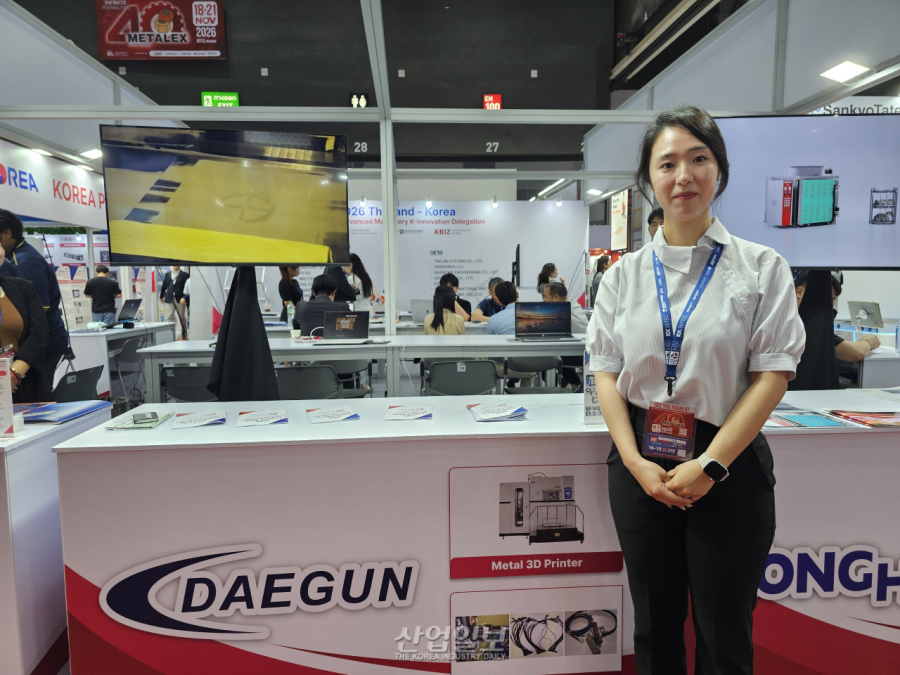
Daegun Tech participated in ME2026, held from June 17 to 20 at the BITEC exhibition center in Bangkok, Thailand, where the company introduced its industrial metal 3D printers and advanced additive manufacturing technologies.
The exhibition was organized by RX BITEC and was held alongside seven other industrial exhibitions, including InterPlas Thailand 2026, InterMold Thailand 2026, Automotive Manufacturing 2026, Surface & Coatings 2026, NEPCON Thailand 2026, Assembly & Automation 2026, and FACTECH 2026.
Through the Korea Pavilion operated by Changwon Industry Promotion Agency (CWIP), Daegun Tech presented additive manufacturing application cases and its industrial equipment lineup to manufacturing companies and industry professionals across Southeast Asia.
Securing Industrial Additive Manufacturing Technology Using Metal Powder
Established in 1998, Daegun Tech has grown based on cable harness manufacturing and industrial equipment production. The company later expanded its business scope by entering the industrial 3D printer market through its own R&D capabilities.
Currently, under the dpert brand, Daegun Tech develops and supplies metal 3D printers and additive manufacturing systems optimized for specialized materials.
The company has secured equipment based on PBF (Powder Bed Fusion) technology, which selectively melts metal powder layer by layer using a laser, enabling the production of complex-shaped metal components that are difficult to manufacture using conventional methods.
The company’s representative equipment lineup includes the M135, M270, and M500 series, which support various metal materials such as stainless steel, aluminum, titanium, and tungsten.
“Manufacturing industries today require both design flexibility and faster development cycles,” said Assistant Manager Minjung Bae. “Additive manufacturing technology enables the production of geometries that are difficult to achieve through conventional machining or casting processes, and its application range is expanding across various industries.”
Expanding Applications into Defense, Aerospace, and Mold Industries
Industrial metal 3D printers are expanding beyond prototype development into actual production of end-use components.
Daegun Tech’s equipment is being supplied primarily to high-value industries such as defense, aerospace, and mold manufacturing.
In particular, large-scale systems equipped with multi-laser technology are designed to meet the demand for manufacturing large metal components while improving productivity.
In the defense sector, the technology is being applied to lightweight components and specialized structures, while in the mold industry, it is used for manufacturing complex molds with integrated internal cooling channels.
The ability to manufacture structures as a single integrated component, which previously required multiple parts to be assembled using conventional manufacturing methods, is also one of the key reasons why additive manufacturing technology is gaining attention.
“Since complex geometries can be produced as a single component, additive manufacturing enables a completely new approach starting from the design stage,” said Assistant Manager Bae. “It offers significant advantages in industries where shorter development cycles and lightweight structures are critical.”
Continued Development of Specialized Material 3D Printers
Daegun Tech is also focusing its R&D capabilities on developing specialized material-based 3D printing systems in addition to metal additive manufacturing technologies.
According to the company, it has developed a 3D printer utilizing magnesium powder and commercialized a dedicated 3D printer for PEEK, a high-performance engineering plastic.
PEEK is a material known for its excellent heat resistance and chemical resistance, and it is widely used in industries such as medical devices, aerospace, and semiconductor manufacturing.
By simultaneously securing both equipment development capabilities and material technologies, Daegun Tech has established a foundation to respond to diverse industry requirements.
Integration of Manufacturing Infrastructure and Additive Manufacturing Technologies
Daegun Tech continues to operate its cable assembly and harness business alongside its additive manufacturing business.
The company supplies cable products applied to machine tool control panels, semiconductor equipment, defense systems, solar energy facilities, and battery manufacturing equipment, leveraging its accumulated manufacturing expertise to strengthen its additive manufacturing capabilities.
Rather than simply supplying equipment, the company is focusing on establishing an integrated manufacturing environment that connects design, production, and post-processing.
“Manufacturing environments are becoming increasingly complex, while development cycles are becoming faster,” said Assistant Manager Bae. “Additive manufacturing technology is not replacing conventional manufacturing methods, but rather complementing them and creating new approaches to production.”
She added, “Southeast Asia is also experiencing increasing demand for manufacturing innovation, particularly in the automotive, electronics, and industrial equipment sectors. We are actively exploring various opportunities to collaborate with local industries.”